- Pipe & Hose Fittings (Hydraulics/Pneumatics) Offered
- sku: 5224122335316641
- SMC KQ2T08-06A1
KQ2T08-06A1 SMC Push Connect Fittings Union Reducer Tube
| Brand | SMC |
|---|---|
| Manufacturer Part Number | KQ2T08-06A1 |
| Part Type | METRIC FITTING REDUCER TUBE |
| Unit Type | UNIT |
| Fitting Shape | TEE |
| Material | PLASTIC |
| End C | FOR TEES |
| Unit Quantity | 20 |
Review SMC Push To Connect Fittings Union Reducer Metric/inch Tube
Introducing the SMC KQ2T08-06A1 push connect fitting, a versatile and convenient solution for joining tubing in various applications. This union reducer is Metric/inch compatible, making it a practical choice for systems that utilize both metric and inch-sized components.
The KQ2T08-06A1 is a push-connect fitting, which means it eliminates the need for threading, welding, or the use of clamps. Instead, this fitting securely connects tubing by simply pushing it into place until it clicks, ensuring a leak-free seal. The union feature allows for easy disassembly and reassembly without the need for additional tools, making maintenance and installation a breeze.
The reducer portion of this fitting reduces the diameter of the tubing by 1:1, making it suitable for use in systems where a size change is required. The Metric size of this fitting is 10mm (0.3937 inches) inlet and 8mm (0.3149 inches) outlet. The inch size is 3/8 inches inlet and 1/2 inches outlet.
Made from high-quality materials, this push connect fitting is suitable for use with various fluids, including water, air, and other non-hazardous liquids. It is designed to withstand the rigors of industrial and commercial applications, providing reliable performance and longevity. The fitting's robust construction includes an internal O-ring seal, ensuring a tight and secure connection that prevents leaks.
In summary, the SMC KQ2T08-06A1 push connect fitting is a must-have component for any system that requires the joining of Metric/inch tubing. Its push-connect design makes installation and maintenance quick and easy, while its union reducer feature allows for size changes and disassembly without the need for additional tools. Its durable construction and reliable seal make it a dependable choice for a variety of applications.
SMC KQ2T08-06A1 push connect fittings with union reducers are versatile plumbing components that offer several advantages and disadvantages for users. These fittings are suitable for both metric and inch tube sizes, making them a popular choice for various applications. Let's explore some pros and cons of using these fittings.
Pros:1. Easy installation: These push-connect fittings do not require any special tools or soldering, making them a quick and easy installation option. They can be connected to tubing by simply pushing them onto the tubing and turning them a quarter turn to lock them in place.
2. Time-saving: The absence of the need for soldering or other complex installation methods makes these fittings a time-saving option for plumbing projects.
3. Cost-effective: SMC KQ2T08-06A1 fittings are generally more affordable than traditional soldered or threaded fittings due to their simpler installation process.
4. Flexibility: These fittings can be used for both metric and inch tube sizes, making them a versatile option for various plumbing applications.
5. Leak-free: The push-connect design of these fittings creates a sealed connection that is less prone to leaks compared to traditional soldered or threaded fittings.
Cons:1. Limited pressure rating: These fittings have a lower pressure rating compared to soldered or threaded fittings, making them unsuitable for high-pressure applications.
2. Longevity concerns: Some users have reported that these fittings may not last as long as traditional soldered or threaded fittings, especially in applications with high water flow or temperature fluctuations.
3. Potential for damage: The push-connect design of these fittings makes them susceptible to damage if not handled carefully during installation or transportation.
4. Limited size availability: These fittings may not be available in all sizes and configurations, which can limit their applicability for certain plumbing projects.
In conclusion, SMC KQ2T08-06A1 push connect fittings with union reducers offer several advantages such as easy installation, time-saving, cost-effectiveness, flexibility, and leak-free connections. However, they have some disadvantages like limited pressure rating, longevity concerns, potential for damage, and limited size availability.
Based on the pros and cons discussed above, these fittings are a suitable option for DIY plumbing projects that require quick and easy installation, and for applications with moderate water flow and temperature conditions. However, for high-pressure applications or where long-term durability is a concern, traditional soldered or threaded fittings may be a better choice. Ultimately, the decision to use these fittings depends on the specific requirements of the plumbing project and the preferences of the user.
Details:
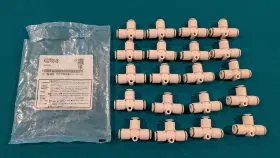
I have 20 of these tee fittings in unused condition that are being sold together and not individually.
specifications pipehosefit:
- brand: Smc
- mpn: Kq2t08-06a1
- part type: Metric Fitting Reducer Tube
- unit type: Unit
- fitting shape: Tee
- material: Plastic
- end c: For Tees
- unit quantity: 20
returns pipehosefit:
- policy: no returns
payments pipehosefit:
- other
- wallet: apple-pay
- credit card: mastercard
offer pipehosefit:
- in stock #: 3
- options: ship-to-home
- availability: in stock
- started: may 29, 2025
- prices: $113.73–$151.27
- item condition: New
- sold #: 22
shipping pipehosefit:
- type: calculated
- service: usps ground advantage
- transit: 4-9 days
- carrier: usps
- class: standard
seller pipehosefit:
- rating: 100.0%
- city: fredonia, wisconsin
- # reviews: 174
general pipehosefit:
- category: Business & Industrial > Adapters > Pipe Hose > Push-to-connect Fittings
Similar Items:
- Smc Krl11-35s Fitting 3 8 Inch One Touch To 1 4 Npt Lot Of 10 Shipping services. 3-T4C-42342-CS. Smc KRL11-35S fitting 3/8 one touch to 1/4 not lot of 10...(January 2nd, 2024)
- Smc Kq2s09-35as Fitting 5 16 Inch One Touch To 1 4 Npt Lot Of 2 3-T4C-42357-CS. Shipping services. Smc KQ2S09-35AS fitting 5/16 one touch to 1/4 not lot of...(January 2nd, 2024)
- Smc Kq2s13-36as Fitting 1 2 Inch One Touch To 3 8 Npt Lot Of 2 3-T4C-42359-CS. Shipping services. Smc KQ2S13-36AS fitting 1/2 one touch to 3/8 not lot of...(January 2nd, 2024)
- Smc Kau08-00 Union Inch Y Fitting 8mm To Lot Of 4 Smc KAU08-00 union y fitting 8MM to lot of shipping services. 3-T4C-42329-CS...(January 2nd, 2024)
- Smc Kqw13-37s Extended Male Elbow Fitting 1 2 Inch One Touch To Npt Smc KQW13-37S extended male elbow fitting 1/2 one touch to not. Shipping services. 3-T4C-42362-CS...(January 2nd, 2024)
- Smc As2301f-n01-06 Bulk Qty 4 Piece Lot Push Lock Pneumatic Flow Control Part #: Smc AS2301F-N01-06 for sale...(January 21st, 2024)
- Smc As1301f-nilm5-03 Bulk Qty 11 Piece Lot Push Lock Pneumatic Flow Control Part #: Smc AS1301F-NILM5-03 for sale...(January 21st, 2024)
- Smc As2201f-n01-06 Bulk Qty 12 Piece Lot Push Lock Pneumatic Flow Control Part #: Smc AS2201F-N01-06 for sale...(January 21st, 2024)
- Smc As2201f-01-06st Lot Of 7 Tamper Proof Flow Controller 1 8r To 6mm Tube Control type: meter out. Lot of 7 Smc tamper proof flow controllers. Piping: 1/4R. Tube fitting: 6MM P2C. Specifications: model #: AS2201F-01-06ST. This is a surplus item...(February 29th, 2024)
- Smc As3301f-n03-07 Speed Control 1 4 Inch Od One Touch Fitting 3 8 Male Npt 6-MM5H-44818-JR. Shipping services. Smc AS3301F-N03-07 speed control 1/4 OD one touch fitting 3/8 male not...(April 10th, 2024)
- Smc Kq2h06-08a One Touch Fitting 6mm 8mm 5 16 Inch Used The cost of combined shipping depends on weight, location buyer and size box. Item is sold as pictured. Used, lot of 10. These services include: ups 3 day select. Prices for these options may differ from standard ground shipping. Ups 2 day air. Ups next day am. Smc KQ2H06-08A one touch fitting, 6MM...(May 3rd, 2024)